Over-ear headphones occupy a strange middle ground in the world of personal audio. They’re bulkier than earbuds, less portable than a pair of budget on-ears, and often priced well beyond what casual listeners expect to spend on headphones. Yet for a certain kind of listener — someone who spends hours on calls, travels frequently, or simply wants the most immersive listening experience possible from a single device — over-ear headphones remain a category worth understanding.
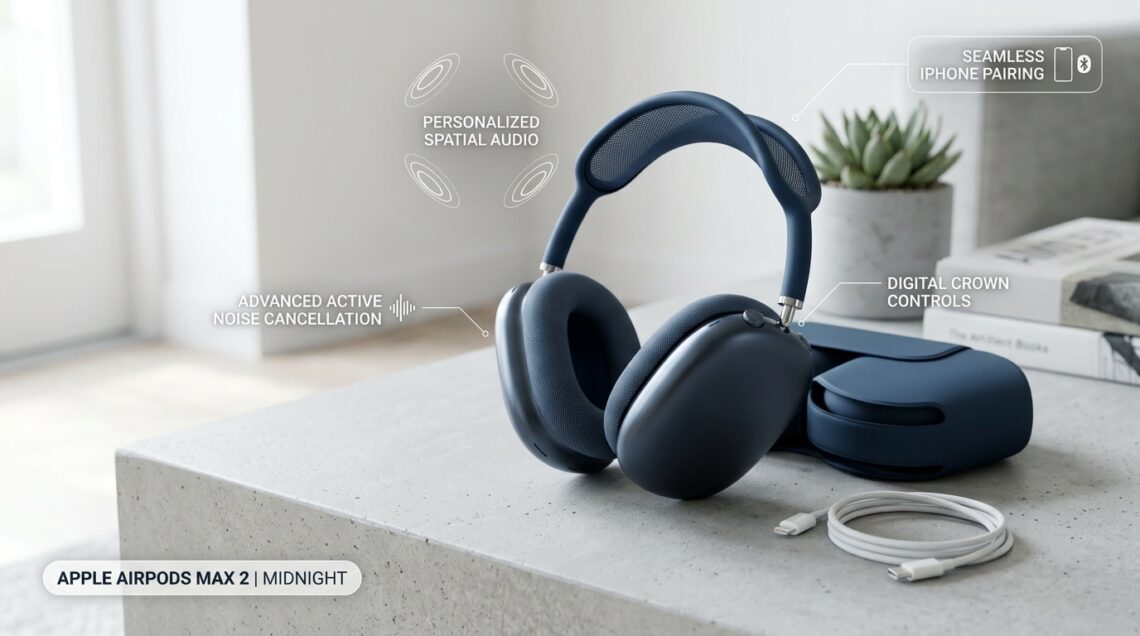
The Apple AirPods Max 2 in Midnight is the latest entry in Apple’s over-ear lineup, arriving several years after the original AirPods Max introduced the company’s take on premium headphones. This second generation keeps the recognizable silhouette — the knit-mesh canopy, the telescoping arms, the memory foam cushions — while updating what’s happening on the inside. The headline change is the shift to Apple’s H2 chip, which brings a set of software-driven features that weren’t available on the first model, including Adaptive Audio, Conversation Awareness, and Live Translation.
This article walks through what the AirPods Max 2 actually offers, how people tend to use headphones like this in daily life, who might find them useful, and what’s worth thinking about before adding a pair to your setup. Nothing here is meant as a definitive verdict — just a grounded overview to help you understand what you’d actually be getting.
Key Features
H2 Chip and Active Noise Cancellation
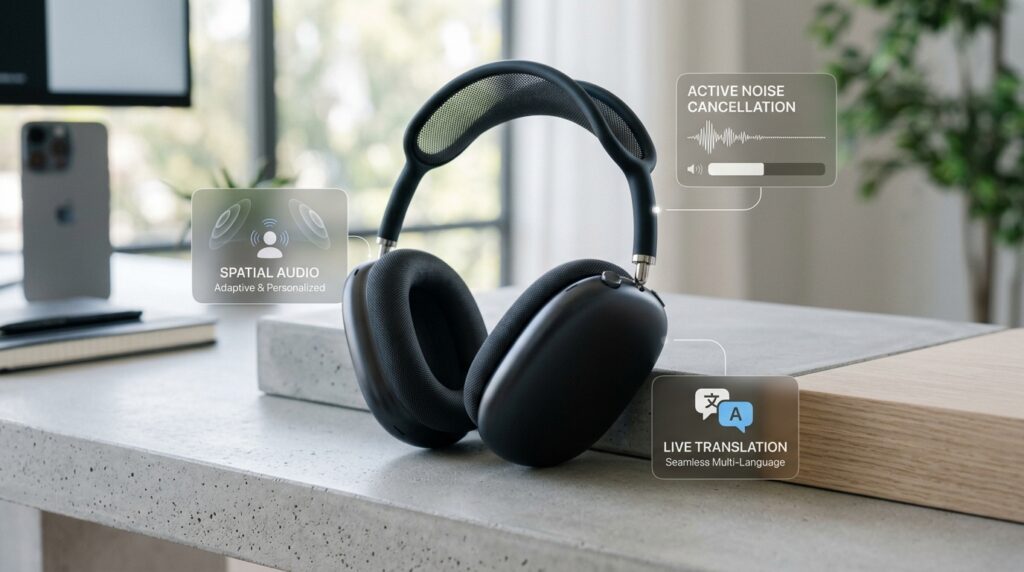
The most significant internal change in this generation is the move from the original H1 chip to Apple’s newer H2 chip. According to Apple, this upgrade enables Active Noise Cancellation that is up to 1.5 times more effective than the previous generation, based on testing conducted in accordance with the IEC 60268-24 standard. The improvement reportedly comes from new computational audio algorithms that generate anti-noise signals to counter a wider range of external sound without degrading playback quality.
For anyone unfamiliar with how ANC works, the basic idea is that microphones on the headphones pick up ambient noise, and the headphones generate an inverse sound wave to cancel it out before it reaches your ears. More effective ANC generally means a quieter listening environment in places like airplanes, open offices, or busy streets — though how noticeable the difference feels will vary depending on your surroundings and hearing.
Adaptive Audio and Conversation Awareness
Adaptive Audio is one of the features carried over from the AirPods Pro line that’s now available on AirPods Max for the first time. Rather than requiring you to manually switch between Noise Cancellation and Transparency modes, Adaptive Audio automatically adjusts the level of noise cancellation based on what’s happening around you — dialing things back slightly in a quiet coffee shop and increasing cancellation on a loud train, for example.
Paired with this is Conversation Awareness, which lowers the volume of whatever you’re listening to and reduces background noise when the headphones detect that you’ve started speaking to someone nearby. In practice, this is designed to reduce the need to physically remove your headphones every time someone wants to ask you a question.
Live Translation
Perhaps the most notable new addition is Live Translation, powered by Apple Intelligence. By pressing and holding the listening mode button, wearers can activate a feature that automatically translates a language someone is speaking into their preferred language, played back through the headphones. According to Apple’s documentation, this requires an Apple Intelligence–enabled iPhone running a compatible version of iOS, along with downloaded language packs for offline processing. Apple states that translation processing takes place on the connected iPhone, and that conversation data is not stored or shared beyond that process.
It’s worth noting that Live Translation is described by Apple as a beta feature at launch, and availability varies by region and language. Apple also notes that because the feature relies on generative models, outputs may occasionally be inaccurate or unexpected, so it’s positioned as a helpful tool rather than a flawless replacement for human translation in high-stakes situations.
Personalized Spatial Audio
Spatial Audio on AirPods Max 2 is tuned to the individual listener using a personalized audio profile based on ear shape, combined with dynamic head tracking. The goal is to simulate a more theater-like sound field, where audio appears to come from specific points in space around the listener rather than directly from the ear cups. This is most noticeable when watching movies or shows that include spatial audio mixes, though it can also apply to certain music content.
Build and Acoustic Design
The physical design carries over Apple’s original approach: a breathable knit-mesh canopy intended to distribute weight across the head, memory foam ear cushions wrapped in a custom textile, and telescoping arms that allow the fit to adjust to different head sizes. Apple also uses a new high dynamic range amplifier in this generation, along with a redesigned Adaptive EQ system that continuously tunes sound output based on the seal created by the ear cushions against the wearer’s ears.
Audio Quality and Connectivity
AirPods Max 2 supports 24-bit, 48kHz lossless audio when connected via the included USB-C cable, along with ultra-low latency audio for tasks like video editing or music production. Wireless connectivity continues to rely on Bluetooth, and the headphones include Apple’s Automatic Switching feature, allowing playback to move between an iPhone, iPad, and Mac depending on which device the wearer is actively using. On-head detection is also present, automatically pausing playback when the headphones are removed.
Battery Life and Additional Controls
Apple states the AirPods Max 2 offers up to 20 hours of listening time with Active Noise Cancellation and Spatial Audio enabled. The Digital Crown returns as the primary physical control, letting users play or pause music, adjust volume, skip tracks, and take calls. New to this generation is a camera remote function, where pressing the Digital Crown can trigger the camera shutter or start and stop video recording on a connected iPhone or iPad — a detail that may appeal to content creators shooting hands-free footage.
How It Can Be Used
Understanding a product’s specs is one thing; picturing how it fits into daily routines is another. Here are some of the more common contexts where over-ear headphones like this tend to get used.
Commuting and travel. Noise-cancelling over-ear headphones are a familiar sight on trains, buses, and airplanes. The physical seal created by over-ear cushions, combined with active noise cancellation, can help create a more consistent listening environment in transit compared to earbuds, which rely more heavily on passive noise isolation from ear tips.
Remote work and video calls. With features like Voice Isolation designed to prioritize the wearer’s voice during calls while reducing background noise, headphones like this are often used in home offices or shared workspaces where background sound is a regular distraction — both for the wearer and for whoever they’re speaking with.
Content creation. The inclusion of studio-quality audio recording, lossless USB-C audio, and camera remote functionality points toward use cases beyond casual listening. Podcasters, musicians, and video creators sometimes look for headphones that double as a monitoring tool during recording sessions, not just a playback device.
Travel and cross-language communication. Live Translation is specifically aimed at in-person conversations where the wearer and another speaker use different languages. This could be relevant for travelers navigating unfamiliar countries, or for anyone who regularly interacts with speakers of other languages in daily life — though it’s worth remembering the feature currently requires downloaded language packs and specific device compatibility.
Home entertainment. Personalized Spatial Audio with head tracking is designed to make movies and certain music content feel more immersive, which some listeners use as an alternative to a home theater setup when watching on an iPad or Mac.
Who It May Be Suitable For
Given the feature set, certain groups may find more practical value here than others.
People already embedded in the Apple ecosystem. Many of the standout features — Live Translation, Automatic Switching, Siri interactions, Personalized Spatial Audio — depend on compatibility with iPhones, iPads, and Macs running specific, relatively recent operating system versions. Someone using Android devices would lose access to a meaningful portion of what makes this generation different from the first.
Frequent travelers or commuters. The combination of improved ANC and long battery life may appeal to people who spend significant time in transit and want a more insulated listening experience.
Remote professionals who take a lot of calls. Features like Conversation Awareness and Voice Isolation are specifically built around the back-and-forth of talking to people while wearing headphones, which may be more relevant to remote workers than to someone who primarily uses headphones for solo listening.
Content creators working within Apple’s software ecosystem. The studio-quality recording and camera remote features are fairly specific tools that will matter most to people already producing audio or video content on iPhone, iPad, or Mac.
People who value spatial audio and premium build materials. Listeners who prioritize sound staging, tactile build quality, and a more theater-like audio experience over portability may find the acoustic design appealing.
Conversely, people looking for the smallest, lightest possible headphones, or those who primarily use non-Apple devices, may find that a different style of headphone suits their needs better.
Important Things to Consider
No product review would be complete without acknowledging trade-offs, and there are a few worth thinking through here.
Feature dependency on software and device compatibility. Several of the newer features, including Live Translation, require specific iOS versions and an Apple Intelligence–enabled iPhone. If your current devices don’t meet these requirements, some of what makes this generation notable may not be accessible right away.
Weight and portability. Over-ear headphones are inherently bulkier than earbuds. Apple states the AirPods Max 2 weighs the same as the original model, at roughly 13.6 ounces (385.5 grams), which is on the heavier side compared to many competing over-ear headphones. For long listening sessions, comfort will vary from person to person depending on head size and how the weight is distributed.
Beta status of Live Translation. Apple has described Live Translation as an available-in-beta feature, meaning it may not yet perform with full consistency, and language and regional availability remains limited. It’s reasonable to treat this as a developing feature rather than a finished, universally available tool.
Charging and cable format. The headphones support wired lossless audio through USB-C, which aligns with Apple’s broader shift away from Lightning connectors, but it’s worth checking that any existing cables or accessories you own are compatible.
Storage case design. Apple’s Smart Case, which typically ships with AirPods Max, has drawn mixed reactions in the past for its minimal coverage of the ear cups. It’s a detail some buyers weigh carefully, since it affects how well the headphones are protected during transport.
Price positioning. As a premium headphone, this product sits at a higher price point than many alternatives on the market. Anyone comparing options should weigh the specific features they’d actually use against the overall investment, rather than assuming more expensive automatically means better suited to their needs.
Comparing General Headphone Categories
Rather than comparing this product directly against specific competing models, it can help to understand where over-ear headphones like this sit relative to other broad categories of personal audio devices.
Over-ear headphones vs. in-ear earbuds. Over-ear designs generally offer a larger physical seal, which can contribute to noise isolation and a fuller sound stage, along with larger drivers for audio reproduction. Earbuds, by contrast, tend to be more portable, easier to carry, and often better suited to workouts or situations requiring more mobility. Over-ear headphones are typically the choice for people who prioritize immersive sound and extended comfort during stationary use.
Wireless vs. wired listening. Devices offering both wireless Bluetooth connectivity and a wired USB-C option — as AirPods Max 2 does — give users flexibility depending on the situation. Wireless connections are convenient for everyday listening, while a wired connection can offer benefits for latency-sensitive tasks like video editing or gaming, along with support for lossless audio formats that some wireless codecs can’t match.
Ecosystem-specific vs. cross-platform headphones. Some headphones are designed to work reasonably well across any Bluetooth-enabled device, prioritizing broad compatibility. Others, like this one, are built with deep integration into a specific ecosystem, unlocking additional features for users within that ecosystem while offering more limited functionality for those outside it. Neither approach is inherently better — it depends on what devices you already use day to day.
Feature-forward vs. minimalist headphones. Some headphones focus primarily on core audio playback with a simple, no-frills approach. Others increasingly layer in software features like adaptive noise control, real-time translation, and AI-assisted voice interactions. The right fit depends on whether you’re looking for a straightforward listening tool or a more multifunctional device that extends beyond music playback.
Frequently Asked Questions
Does Live Translation work without an internet connection? According to Apple, once the relevant language packs are downloaded, processing for Live Translation happens on the connected iPhone rather than requiring a continuous internet connection. However, downloading the initial language packs does require connectivity.
Do these headphones work with Android phones? Basic Bluetooth playback functions with non-Apple devices, but many of the standout features — including Live Translation, Personalized Spatial Audio setup, Automatic Switching, and Siri interactions — are designed specifically around Apple’s ecosystem and iOS software.
How long does the battery last? Apple states up to 20 hours of listening or video playback with Active Noise Cancellation and Spatial Audio enabled, though actual battery life can vary based on volume levels, feature use, and environmental conditions.
Can I use these for phone calls? Yes. The headphones include multiple microphones designed for voice pickup, along with Voice Isolation, which is intended to prioritize the wearer’s voice during calls while reducing background noise.
What’s the difference between Active Noise Cancellation and Adaptive Audio? Active Noise Cancellation actively reduces external sound using anti-noise signals, while Adaptive Audio automatically adjusts the intensity of that noise cancellation (or switches toward Transparency) based on the wearer’s environment, aiming to strike a balance between blocking noise and staying aware of surroundings.
Are these headphones water resistant? Apple has not marketed AirPods Max as water resistant in the way some of its earbud models are, so it’s worth treating them as headphones best suited to everyday indoor and travel use rather than workouts involving heavy sweat or exposure to moisture.
What colors are available? This particular listing is in Midnight, though Apple has released the AirPods Max 2 in a broader range of colors, including starlight, orange, purple, and blue.
Conclusion
The AirPods Max 2 represents a fairly substantial internal update to Apple’s over-ear headphone line, even though the external design remains close to its predecessor. The move to the H2 chip brings a set of features — Adaptive Audio, Conversation Awareness, Live Translation, and improved noise cancellation — that were previously exclusive to Apple’s earbud lineup, along with quality-of-life improvements to spatial audio and sound reproduction.
Whether this particular headphone makes sense for you likely comes down to a few practical questions: how deeply you’re already using Apple devices, whether real-time translation or hands-free camera control are features you’d actually use, and how much you value the specific comfort and acoustic design Apple has built around the over-ear format. For some listeners, especially those calling on multiple Apple devices throughout the day or traveling across language barriers, the feature set may offer genuine day-to-day usefulness. For others whose needs are simpler, a more streamlined pair of headphones might be a better fit.
As with any higher-investment piece of technology, it’s worth taking the time to match the feature list against your actual habits before deciding. You can check more details on Amazon here.