Wireless earbuds have become such a routine part of daily life that it’s easy to forget how much technology is actually packed into these small devices. Apple’s AirPods 4 represent the company’s continued refinement of the earbud category, introducing features that were previously reserved for the higher-end AirPods Pro lineup. For anyone trying to make sense of what these earbuds offer, how they work, and whether they might fit into their own routine, this article breaks down the practical details without the marketing gloss.
What Are the AirPods 4, Exactly?
The AirPods 4 sit within Apple’s broader earbud family, positioned as a step above the previous generation while maintaining the open-ear design that many users associate with the standard AirPods line. Unlike the AirPods Pro, which use silicone tips that create a seal inside the ear canal, the AirPods 4 generally maintain a more open fit, though Apple has introduced versions with Active Noise Cancellation that bring some Pro-level functionality into this more accessible design.
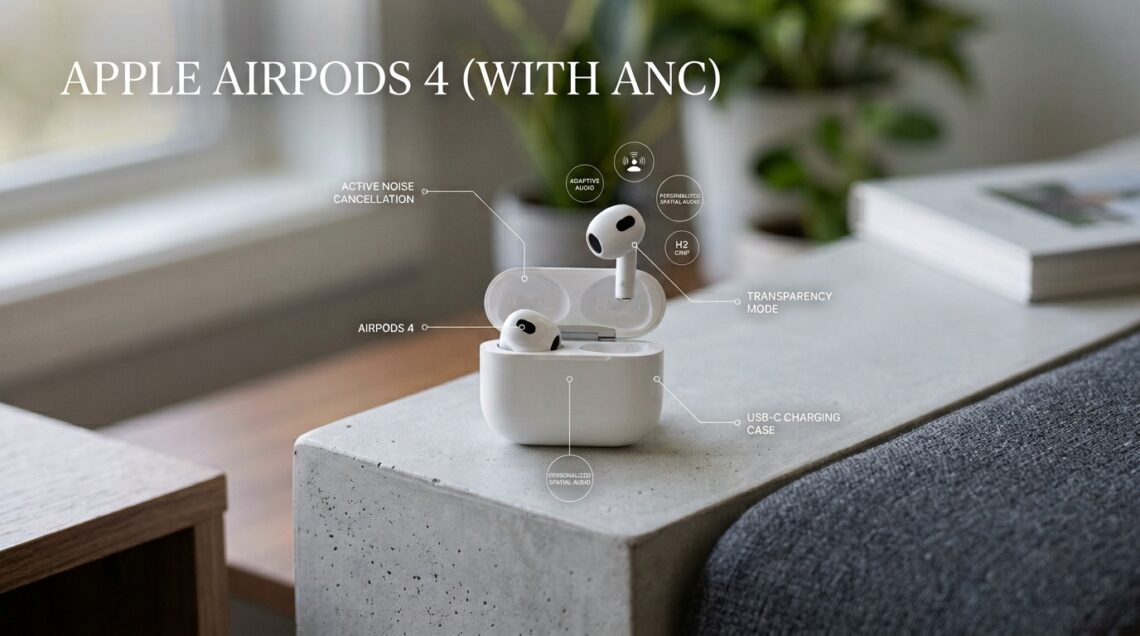
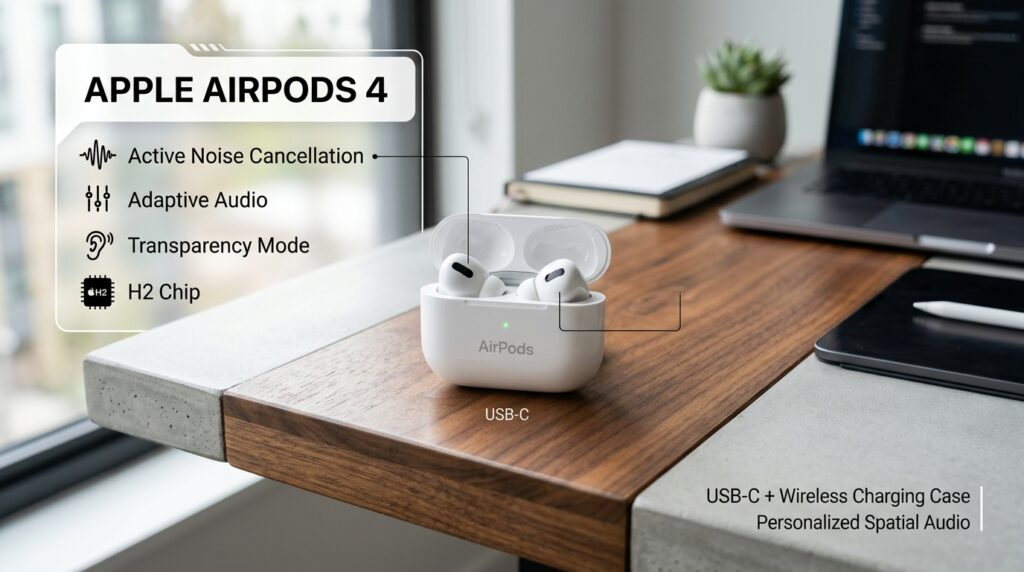
They’re built around Apple’s H2 chip, the same silicon architecture found in the AirPods Pro, which handles everything from audio processing to noise management. This is a notable shift because it means capabilities that once required a sealed-tip design are now being extended, in modified form, to an open-ear earbud.
Key Features Worth Understanding
Active Noise Cancellation and Adaptive Audio
One of the more talked-about additions to this generation is Active Noise Cancellation (ANC). Traditionally, ANC has worked best with in-ear designs that physically block outside sound, then use microphones and processing to cancel remaining noise. Apple’s approach with the AirPods 4 uses the H2 chip to computationally manage ambient sound even without a deep ear seal.
Adaptive Audio is a related feature that adjusts the balance between blocking outside noise and letting it through, depending on the environment. Rather than requiring the user to manually switch between noise cancellation and transparency mode, the system aims to respond to changing surroundings in real time — for instance, dampening a noisy street but easing up when someone starts speaking to you.
Transparency Mode
Transparency Mode allows external sounds to pass through the earbuds, which can be useful in situations where full noise isolation isn’t desirable, such as walking near traffic, being in an office setting, or wanting to remain aware of your surroundings while still listening to audio.
Personalized Spatial Audio
Spatial Audio simulates a multi-directional sound field, giving the impression that sound is coming from various points around the listener rather than directly from the earbuds. The “personalized” aspect uses a scan of the listener’s ear geometry (often done through the iPhone’s camera) to tailor this audio effect to individual anatomy. This feature tends to be most noticeable when watching video content or listening to music mixed specifically for spatial formats.
H2 Chip
The H2 chip is the processing core behind most of these features. It manages noise control computations, audio tuning, and communication between the earbuds and connected devices. Chips like this are part of why modern earbuds can handle complex audio processing without noticeable lag or major battery drain.
USB-C Charging Case with Wireless Charging
The charging case has moved to USB-C, aligning with the broader shift across Apple’s product lineup and most Android devices, which simplifies cable management for people who already use USB-C chargers for other electronics. The case also supports wireless charging, meaning it can be placed on a Qi-compatible charging pad without needing to plug in a cable each time.
How the AirPods 4 Can Be Used in Daily Life
Wireless earbuds like this tend to fit into a wide range of daily scenarios, and understanding these use cases can help clarify whether a product like this aligns with someone’s lifestyle.
Commuting and Travel For people who walk, bike, or take public transit, the combination of Transparency Mode and Adaptive Audio can be relevant. Being able to hear approaching vehicles or announcements while still listening to a podcast or music is a practical safety consideration, not just a convenience feature.
Work and Calls Earbuds with built-in microphones and noise processing are frequently used for phone calls, video meetings, and voice assistants. The H2 chip’s audio processing may help with call clarity, particularly in moderately noisy environments like a shared office or a café.
Exercise and Movement Some users prefer earbuds during workouts because they’re lighter and less likely to fall out during high-movement activities compared to over-ear headphones. The open-ear design of the AirPods 4 (in the non-ANC version) can also allow more environmental awareness during outdoor activity.
Media Consumption For watching movies, TV shows, or listening to music that supports spatial audio formats, the Personalized Spatial Audio feature is designed to create a more immersive listening experience compared to standard stereo playback.
Everyday Multitasking Many people use earbuds simply to stay connected throughout the day — taking calls while doing chores, listening to audiobooks while commuting, or managing notifications hands-free.
Who Might Find These Earbuds Suitable
Different people have different needs when it comes to audio devices, so it’s worth thinking through who this type of product tends to serve well.
- Existing Apple ecosystem users often find that AirPods integrate smoothly with iPhones, iPads, and Macs, including features like automatic device switching and Find My integration.
- People who prioritize a lighter, open-ear feel over the deeper insertion of silicone-tipped earbuds may prefer this design, especially if they’ve found in-ear designs uncomfortable in the past.
- Frequent commuters or pedestrians who want some noise management without full isolation from their surroundings may appreciate the Adaptive Audio and Transparency Mode combination.
- Casual to moderate audio users who want solid everyday functionality without necessarily needing the full feature set of the AirPods Pro (such as deeper ANC or interchangeable ear tips).
That said, this product may be less suited to individuals who specifically want maximum noise isolation for environments like frequent flying or loud workplaces, where a sealed-tip design generally performs more effectively.
A General Comparison of Earbud Categories
Rather than comparing this product directly to named competitors, it can help to understand where the AirPods 4 fits within broader categories of wireless earbuds available on the market.
Open-Ear vs. Sealed-Tip Earbuds Open-ear designs, like the standard AirPods 4, tend to prioritize comfort and environmental awareness, while sealed-tip designs (like the AirPods Pro or many competitor products) typically offer stronger passive noise isolation. Neither approach is universally “better” — it depends on the listening environment and personal preference.
Budget vs. Premium Earbuds Earbuds across the market range widely in price and feature sets. Lower-cost options often skip features like ANC, spatial audio, or wireless charging cases, while premium options tend to bundle more of these capabilities together. The AirPods 4 generally sits in the mid-to-upper range of mainstream consumer earbuds, particularly with the ANC-equipped version.
Ecosystem-Specific vs. Cross-Platform Earbuds Some earbuds are designed to work equally well across all operating systems, while others — like AirPods — are optimized primarily for one ecosystem. This is an important distinction for anyone who splits time between different device brands.
Frequently Asked Questions
Do the AirPods 4 work with Android devices? They can connect via standard Bluetooth pairing, and basic functions like music playback and calls should work. However, several Apple-specific features may not be available or may function differently outside the Apple ecosystem.
Is Active Noise Cancellation the same as in the AirPods Pro? Not exactly. The AirPods Pro use a sealed ear-tip design that physically blocks more outside noise, while the AirPods 4’s ANC operates within a more open-ear structure, relying more on software-based processing.
Can the case be charged wirelessly? Yes, the case supports wireless charging in addition to USB-C cable charging, giving users flexibility in how they recharge the earbuds.
What is Personalized Spatial Audio, and do I need special content for it? Personalized Spatial Audio works best with content specifically mixed for spatial or Dolby Atmos formats. Standard stereo content will still play, but the spatial effect is generally most noticeable with compatible media.
Are these earbuds sweat or water resistant? Specific resistance ratings should be checked directly against the official product specifications, as these details can affect suitability for workouts or outdoor use.
How does the H2 chip affect performance? The H2 chip is responsible for processing tasks like noise management and audio tuning. It generally allows for more efficient computation, which can influence both audio quality and battery efficiency compared to earlier chip generations.
Final Thoughts
The Apple AirPods 4 reflect a broader trend in wireless earbuds: bringing advanced features like noise cancellation, spatial audio, and wireless charging into more accessible product tiers rather than reserving them for flagship-only models. Whether this particular model suits an individual’s needs really comes down to personal priorities — comfort preferences, ecosystem alignment, and how the earbuds will primarily be used day to day.
You can check more details on Amazon here.